

This is the 3rd in a series, The Psychology of Facing Hard Truths. Part 1, The Desire Not to Know, discusses the psychology of avoiding distressing, painful truths. Part 2, When We Look Away looked at the neuroscience about hard knowledge. This piece is about what to do with it.

Take a moment and think about the places and contexts where we meet the hard truths about our world.
Not in the abstract, but the specific places where distressing news is delivered to us. A museum hall, in a documentary, a keynote? A plenary, a closed-door private dinner? A social media reel, sitting in your living room? A classroom?
The single biggest determinant of whether a hard truth changes anything, is not the truth itself.
What science tells us, is the conditions we’re in when we receive it. Specifically, the relational conditions.
Get those conditions right, and people can take in what would otherwise be unbearable, and do something with it. Get them wrong, or leave them to ad hoc chance—which is mostly what we do—and even the best most pertinent, life changing information doesn’t get integrated.
Those conditions have a name. I call it a container, and building one is a learnable practice. I want to talk a bit about how.
[for more context please make sure you’ve read this touchstone piece, below]

Where the hard truths actually land
Let’s start with where it is often absent. (No shade here, we are all learning and evolving our practices for an increasingly shocking and changing world.)
You’re walking through a natural history museum on a Saturday. The hall is gorgeously lit, and you come to an exhibit about human impacts on our planet—the species gone, the ones threatened and vulnerable, the numbers rendered in clean museum typography, beside a case of specimens that no longer exist anywhere but here. (Ouch.) You feel something move in you, a pang of grief or awe or both. And then you read the next placard, and the one after that, and eventually you find the café, because it is lunchtime and the kids are hungry.
Or you’re at home watching a documentary. The cinematography is extraordinary, the reef luminous and then bleached, the music doing exactly what it’s intended to. At the end, a card comes up with the statistics and a website, the call for action, the credits roll. And you sit for a moment in the blue light before you get up, rinse your mug, and go to bed
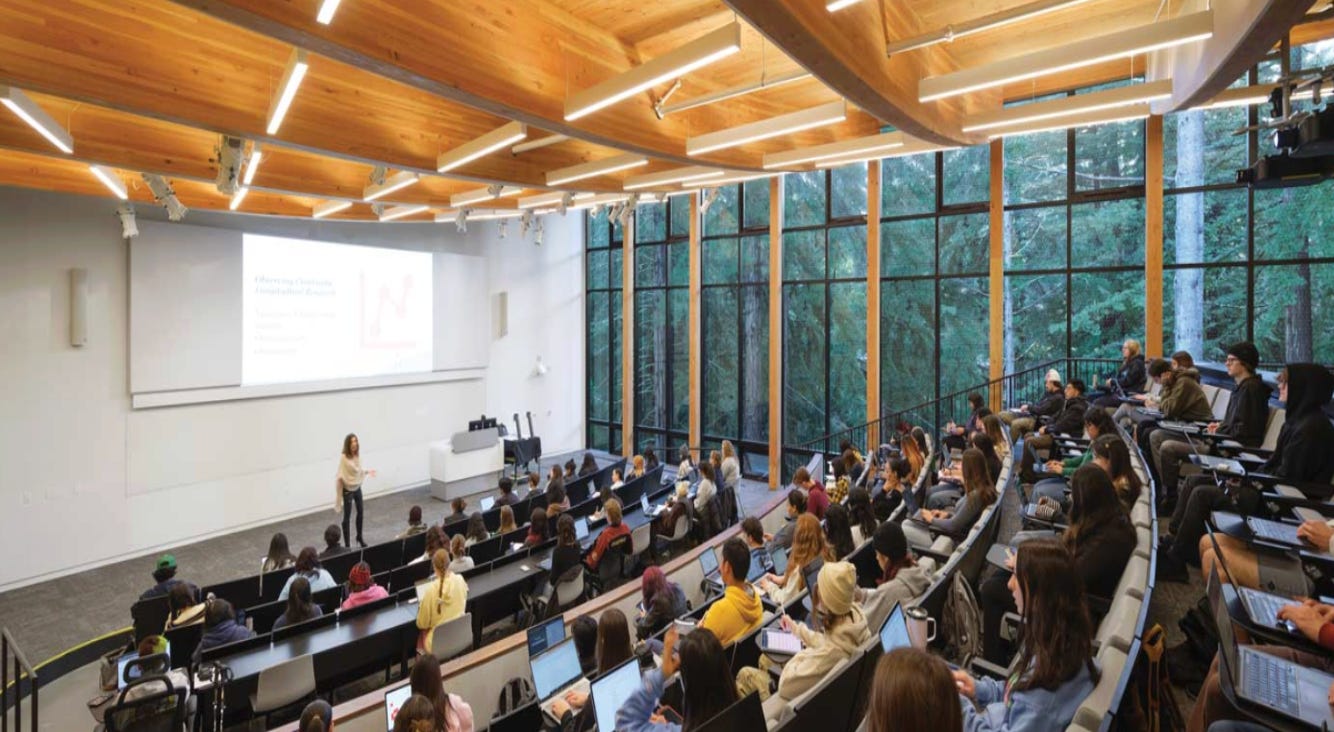
Or maybe you’re at a conference, watching a talk from the stage, watching graphs on the screen. The data is irrefutable (about food system collapse, water, species, climate, temps, waste, plastic, etc.) It’s a great talk. And then there’s the break, the coffee line, you’re half-thinking about the talk, and half-scanning the room for someone you’re hoping to run into.
In every one of these situations, the content is excellent, well-researched, talented people involved, and often delivery was masterful. Years of craft went into that exhibit, that film, that keynote. I know, I work with these people every day.
And yet what is almost always missing is something fundamental. A design flaw. Underneath that flaw is a persistent mindset, that overlooks the neuroscience about how people process and metabolize difficult, complex truths - something I wrote about in “Why Are We Still Asking the Same Questions."

There’s rarely the conditions anywhere in the design, for what we had just taken in, to be held long enough to process, integrate, connect to anything else, to be felt without becoming unbearable, to survive the inevitable cadence of ordinary life. We’re handed hard truths, then asked to somehow hold it while moving on to the next thing. Then, wonder why our work is not reaching more people, not leading to more action and change at scale.
This is exactly the pattern my first 2 pieces in this series outlined. In The Desire Not to Know, inspired by my colleague Marshall Alcorn’s book “Resistance to Learning,” I discussed the research on our human reluctance to fully take in what we already, on some level, understand. In When We Look Away, I followed that reluctance into the nervous system—how information can be received, briefly registered, and then diverted, frogmarched away, at the precise point where it would ask us to feel something we may not yet ready to feel. The museum, the documentary, and the conference are examples of many places where the truth arrives and then, because nothing holds it, slips its moorings. We push it away, or get distracted.
The world continues to wait for our attention. For our care, for our actions and our love.
This is how our minds work
And this is not a personal weakness. It is how minds are designed. Neuroscientist Antonio Damasio, whose work anchored the last piece and hugely informs my own thinking on changemaking, writes in Descartes’ Error:
“How we feel acts as a gateway to our thinking and learning, by providing the bridge between rational (prefrontal cortex) and nonrational processes (brainstem and limbic structures).”
Feeling is not the enemy of clear thinking; it is the bridge information has to cross to become thinking at all. When that crossing is charged with feeling (fear, disgust, anger, fear, etc) when the news is threatening and we’re essentially alone with it, the bridge does not hold. We can’t take it in.
What keeps this bridge open, is not about making better arguments or more stunning visuals, but the conditions around our experience of the content. The Harvard social neuroscientist Matthew Lieberman is direct about what those conditions are:
“People are more receptive to new information when it is delivered in the context of social connection, rather than confrontation.”
If we can take just even these two insights in, grounded in research, the design problem of our changemaking practices comes into focus.
If feeling is the gateway to learning, and connection is what holds that gateway open, then delivering hard truths to people who are alone—and a crowd is not the same as connection—is close to the least effective thing we can do, however good the truth and however beautiful its delivery.
What a container is
A container describes simply the relational and emotional conditions that let a difficult truth be received and stay received, long enough to connect to something, to be felt without overwhelming, to become something a person can actually live with rather than has to push away.
The concept of a container has become popularized in recent years, as trauma work has gotten more mainstream. It’s origins go back to the concept of the psychotherapeutic container, and before that, of course, thousands of years of councils and wisdom practices designed specifically for these purposes. Humans know about containers, we just forgot them.
(See, for example this piece on the role of containers in so-called impact work.)

Containers are less a “place” than a quality of holding. An influencer or an artist on a stage can create a container by the empathy and quality of connection they offer. And while it can sound abstract, the practices that create it are concrete, and most skilled changemakers already know a version of them in their bodies. What follows is a way of naming them, so we can do them on purpose.
Building containers
The first move is to put connection before content. Lieberman’s finding is not a nicety; it is a sequence. Before you bring people the hard thing, or the event or the gathering or the meeting, bring them into some real relationship with each other, even briefly—a genuine question answered in a pair, a moment of being known rather than addressed. The information that arrives in a connected nervous system, that has registered it’s not alone, is the difference between reception and deflection.
The second is to slow down and leave room. The pause after something hard is said is not empty; it is where our thought can link to other thoughts, that form new insights and possible implications, or fails to. Most of our formats are built to prevent exactly this pause: the next slide, the next speaker, the coffee line, the short breaks, the pressured breakouts. Guiding means protecting the space for something to land before we rush to what is next.
The third is to ask rather than tell. This is the shift from the righting reflex to guiding that runs through all my work. A question that evokes—what comes up for you here, what does this stir, etc—opens the gateway. Reflection is the precursor for skillful action! That is neuroscience. A statement that pushes, however true, makes our minds defend, and Lieberman’s “confrontation” insight is precisely what closes us down. We’re not trying to get a truth into people. We are not transmitting data into empty receivers (see this piece about that). We’re trying to create the conditions in which they can bring it in themselves.
And the fourth is to work at the scale of the small group, and over time. A container is far easier to build for 5 people than 500, and change moves fastest in well-held small groups that give people the cadence of human contact a plenary never can. This is why I recommend over and over, that with larger groups, break them up, even if its a conference over a couple of days. This gives people a space to land and process. This is also why a single well-designed conversation beats a brilliant one-off broadcast: integration is not an event, but a relationship, sustained past the moment the information was delivered.
Not soft skills, this is the actual work
None of this is “soft,” and none of it is a supplement to the real work. This is the mechanism by which our solutions get traction. When we treat the conditions of reception as an afterthought—deliver the truth well, and hope it takes—we’re working against how minds are built, and then wondering why the excellent information did not move anyone.
Let me say this again: when we treat conditions, and how people process hard truths and information as an afterthought, we are enacting the same problematic mindset that led to our crises—one of separation, of disconnection, of splitting body from mind, heart from logic, individual from collective. It’s separatistic. It’s ineffective. And it’s harmful.
When we treat those conditions as the work, we start investing in the things that actually determines whether any of it matters: not what we say, but what we build around the saying. And we invest in bringing in the right skillsets, the right expertise, and open up for partnerships in entire new ways.
Thsi is the work that is needed. If you are focused on activating people, on healing our planet, we have to consider the conditions that enable us to access our highest and most capable capacities. And that is in relationship, in safe containers. Not shoving a checklist at people.
That is the whole of this series in a nutshell—and honestly, the underpining of Becoming Guides and evolving our changemaking to the next level.
The problem has never been that people do not know. It’s never been that people don’t care. It is that knowing, on its own, often has nowhere to go.
Our job is to build the places it can go, relationally, emotionally, cognitively and in the real world. And that, unlike the crisis itself, is fully within our hands.
With care,
Renée
New Podcasts Out!
I don’t do a great job at sharing and promoting my podcasts and interviews - here are a few latest, great and thoughtful discussions. Check them out and share if inspired.
Podcast, Climate Magic with Sarah Jaquette Ray
Interview for this Atmos piece Our Uncertain World Is Fueling a New Search for Aliens
Renée, what you’re naming is the structural flaw in how modern institutions deliver hard truths. In ATI terms, information without a container is just signal — it hits the field, overwhelms the nervous system, and dissipates before it can integrate. Minds don’t reject truth; they reject unheld truth.
Your framing makes the design problem unmistakable: if feeling is the gateway to learning, and connection is what keeps that gateway open, then the real work isn’t the content — it’s the conditions around the content. A pause, a question, a small group, a moment of human contact: these are not soft skills; they are the architecture that allows complexity to land.
We don’t need more information. We need better containers — places where truth can be metabolized rather than endured.
I love the idea of building a container. When I revise my *Mindshifting: Conflict and Collaboration*, I’m going to steal that.